
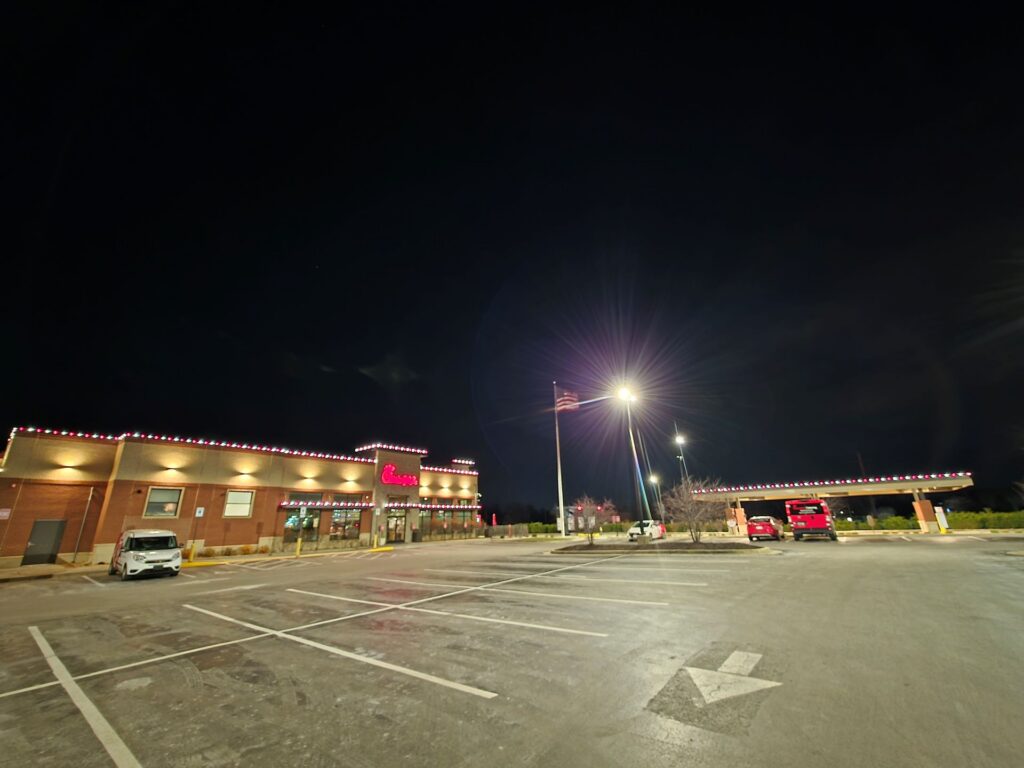
Safer Milwaukee Parking Lots Start with Better Lighting
Good parking lot lighting is about more than seeing where to park. It shapes how safe people feel when they walk to their car, how well drivers can see ice and curbs, and how your business looks after dark. When the sun sets earlier and the weather turns, weak or uneven lighting can turn a normal lot into a stressful place.
Many lots feel dim in some spots and harsh in others. You might see dark gaps between poles, bright headlights fighting with overhead glare, and old fixtures that buzz and flicker. A professional lighting audit helps find these trouble areas before they turn into accidents, complaints, or security problems.
In this guide, we break down three building blocks of safer lots: footcandle targets, uniformity ratios, and cutoff fixtures. We keep it simple and practical so facility managers, property owners, and business leaders around Milwaukee can get ready for shorter days and tougher weather with clear next steps.
Why Milwaukee Businesses Need a Parking Lot Lighting Audit
A commercial lighting audit is a careful look at how your lot really performs at night. It is not just standing outside and saying, “seems bright enough.” A proper audit usually includes:
- On-site light measurements across drive lanes, parking spaces, and walkways
- A map of every fixture, pole height, and aiming direction
- Notes on glare, shadows, and dark corners people might avoid
- A check against local codes and current best practices for safety lighting in Milwaukee and nearby communities
Our local weather makes this even more important. Long winter nights, overcast skies, and blowing snow all cut down on natural light. Ice and slush can cover lines on the pavement and hide potholes or raised areas. When your lighting is weak or patchy, people miss tripping hazards, low curbs, or small obstacles.
This is not just a comfort issue. It can affect:
- Slip and fall incidents in areas near drains or sloped pavement
- Low-speed fender-benders where sight lines are poor
- Security worries in dark zones where people feel watched but cannot see faces
Well-planned lighting can help reduce claims, match what insurers often look for in safety lighting, and support a strong brand image. A bright, even lot sends a clear message: you care about people’s safety before they even walk in the door.
Footcandle Targets That Actually Improve Safety
Footcandles are a simple way to measure light levels. One footcandle is the amount of light that hits a surface one foot away from a standard candle. In plain terms, it is how much light actually reaches the ground, not how strong the bulb looks from a distance.
Judging brightness by eye is tricky. Human eyes adjust fast. An area can feel bright when you first walk in, but cameras may still struggle, and details on the ground may not show well. That is why we use target footcandle ranges instead of guesswork.
Different zones in a lot often need different light levels:
- Driving aisles so drivers can see people stepping out from between cars
- Parking spaces so people can see lines, cart corrals, and bollards
- Pedestrian paths and building entries so faces and trip hazards are clear
Better levels in these areas help with facial recognition, so cameras and security staff can tell who is who. They also make it easier to see ice patches, broken asphalt, or debris.
Seasonal changes in Milwaukee bring another layer. Wet pavement can reflect light and feel brighter than it really is. Fresh snow can bounce light around and trick your eyes, then a few days later that snow turns dirty and stops reflecting as much. A good audit takes these shifts into account and sets targets that work when conditions are at their worst, not just on a clear, dry night.
Getting Uniformity Ratios Right Across the Lot
Even more than how bright a lot is, how even that light is can affect how safe it feels. This is where uniformity ratio comes in. It compares the average light level in an area to the minimum, the darkest spot we measure.
If some spots are very bright and others are much darker, your eyes are always working to adjust. That makes it harder to see movement in the shadows or a person stepping out of a dark area into a bright one. It also creates blind spots that both drivers and cameras struggle with.
Typical targets for commercial lots aim to keep the average-to-minimum ratio fairly low. That means your dimmest areas are still pretty close to your average level, with no sharp drop-offs. Getting there is about design choices more than simply using larger fixtures.
Key design factors include:
- Pole spacing so beams overlap correctly instead of leaving gaps
- Mounting height so light spreads wide without flooding neighbors
- Aiming angles so each fixture shares the load instead of blasting one small area
When uniformity is right, you see fewer “black holes” between poles. Delivery trucks can pull through without losing sight of pedestrians. People walking from the lot into the building do not have to squint as they pass from one zone to the next. The whole space feels calmer and more controlled.
Cutoff Fixtures That Reduce Glare and Light Trespass
Cutoff fixtures are about where the light goes, not just how bright it is. Full-cutoff and cutoff fixtures are built to send most of their light downward, onto the pavement and walkways, instead of into the sky or sideways into windows.
Without this control, you get glare, that blinding effect when a bright source hits your eyes directly. Glare can:
- Temporarily blind drivers as they turn or back out
- Wash out security camera images so faces look like white blobs
- Cause headaches or complaints from neighbors and tenants
By choosing fixtures that shield the light source and using proper aiming, we can keep the brightness on the ground where it helps and out of people’s eyes. Beam spread matters too. Narrow beams work well for tall poles over wide aisles, while wider beams handle rows of parking spaces.
Color temperature also plays a role. Cooler white light can feel harsh in mixed-use or residential areas. Warmer or neutral tones often feel more welcoming while still giving good detail for security. In Milwaukee business districts and areas next to homes, thoughtful choices here help control light trespass and support good relationships with nearby properties.
Turning Audit Results Into a Safer, Smarter Lot
A lighting audit only helps if it turns into action on the ground. This is where a professional team like Rocket Lighting comes in. After gathering readings, photos, and layout notes, we turn that data into a clear plan.
A strong upgrade plan will usually:
- Flag the highest-risk dark zones first, like entries, walkways, and corners
- Recommend fixture types with proper cutoff, beam spread, and color temperature
- Look at energy-efficient LED options that give more useful light with less waste
- Adjust pole locations or heights where spacing is hurting uniformity
Long-term reliability also matters. Quality materials and precise installation help fixtures stand up to wind, snow, and freeze-thaw cycles. Smart controls like timers, photocells, and dimming schedules let your system respond to changing daylight and business hours automatically, which keeps light where you need it without wasting energy.
For Milwaukee-area property owners and managers, a focused parking lot lighting audit is one of the simplest ways to improve safety lighting in Milwaukee, lower risk, and create a better experience for everyone who sets foot on your property after dark. When lighting is planned instead of guessed, your lot stops being a worry and becomes a quiet, reliable part of how your business takes care of people.
Protect Your Property With Proven Lighting Solutions
If you are ready to upgrade your building’s security and visibility, our team can design and install targeted safety lighting in Milwaukee tailored to your needs. At Rocket Lighting, we evaluate your property, recommend the right fixtures, and handle every step of the installation to keep people and assets safer. Tell us about your project and timelines through our contact page so we can get you a clear plan and estimate.